
A course can teach you the vocabulary in an afternoon. It cannot tell you whether the category page you changed answers a buyer's question better. For that, pick one page you can edit and keep a record of what happened.
At the end of this plan, you should have a small case file: the original page, a reason for one edit, the published version, and a check of what Google and readers could actually see. "Google hasn't recrawled it yet" is a useful finding. Calling that a failed SEO test would be premature.
Before day 1: choose a page with room to improve
Use a buying guide, a product-category explainer or a service page you control. Skip checkout pages and sweeping sitewide rewrites. Write down the page URL, who it helps and the question it should answer. Save a copy of its current text. If it belongs to a client, get permission to view its performance data and make edits.
One useful question might be, "Will this replacement part fit the 2022 model?" Do not answer it from a generated guess. You will need the manufacturer's compatibility table or your own verified catalog data. This is a teaching example, not a claim about a Meetanshi client's inventory.
If you need a syllabus, compare the 11 AI SEO learning paths in our course guide. Pick by the type of feedback you need: self-paced reading for foundations, an assessed course for structure, or live review for a page you're responsible for. Check price and access on each provider's current site before paying.
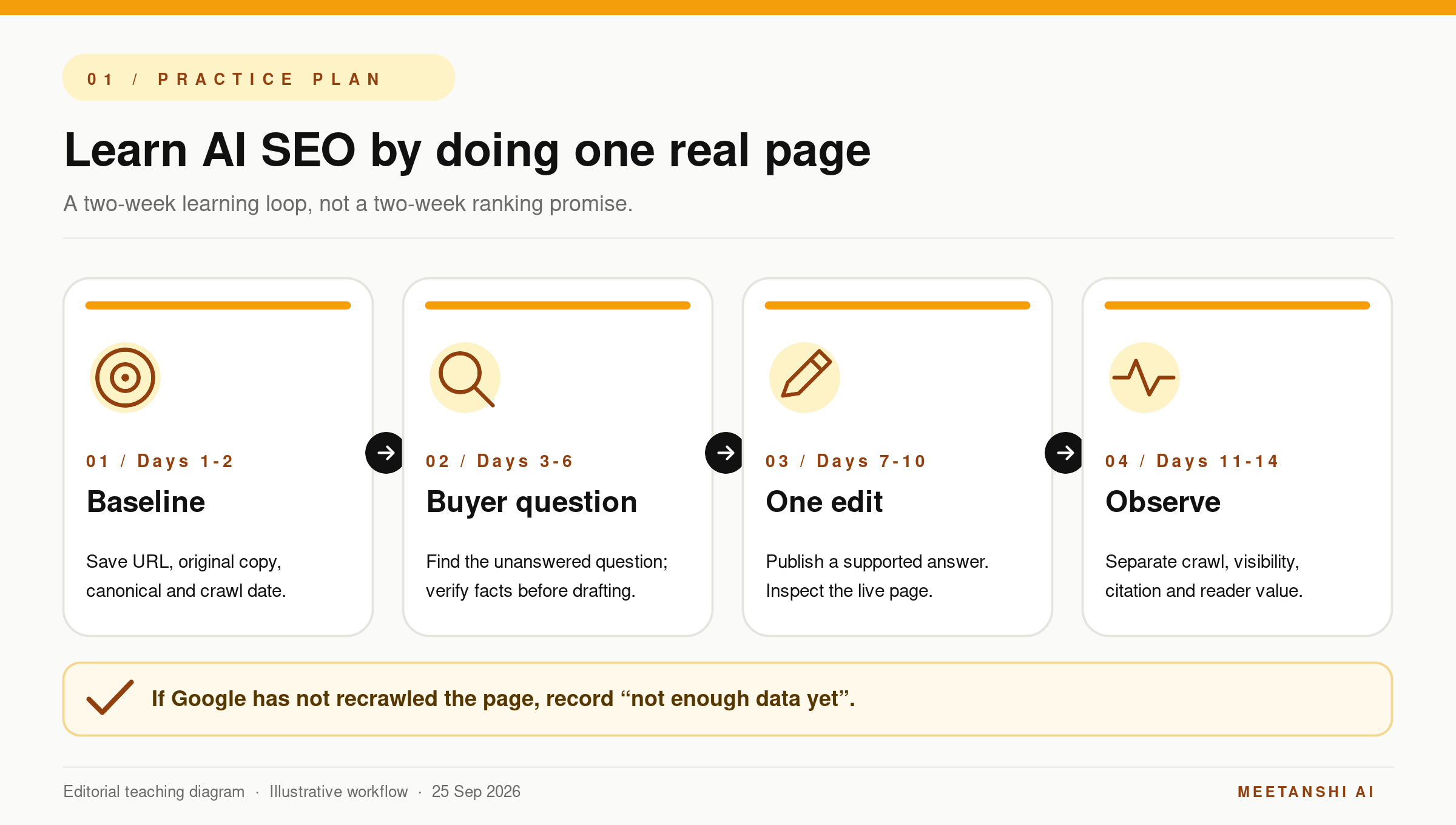
Days 1-2: freeze a baseline
Open the page on a phone and desktop. Save the title, H1, opening answer, canonical URL and a screenshot. Inspect the URL in Google Search Console. Record whether Google indexed it, Google's selected canonical and its last crawl. Google says a supporting link in AI Overviews or AI Mode must be indexed and eligible to appear with a snippet. That is eligibility, not a promise of selection (Google Search Central).
Then filter the Search Console Performance report to the page. Note the date range, country, clicks, impressions and queries actually displayed. A page-wide average position is not the rank of one query. If the query rows are withheld or sparse, write that down.
Keep a separate observation of a relevant search: exact query, country, date, device, ordinary results, and any AI Overview or AI Mode links. A brand mention without a link to your page is not a citation. One screenshot is one sample.
Copy this baseline card into your notes:
Page URL and buyer question:
Indexed? / selected canonical / last crawl:
Search Console date range, country, clicks, impressions, visible queries:
Exact search query, country, device, timestamp:
Organic result observed? / AI Overview present? / AI Mode linked URLs?:
Original opening answer and screenshot location:
Days 3-4: find the missing answer
Read the visible search results for your question. Are people looking for a definition, a procedure, a comparison or a product? Next, read your page as if you could not edit it. Mark the sentence where a reader gets an answer, if there is one.
For the replacement-part example, the answer is not "compatible with leading models." It is a model and revision match, with the source and any exceptions. Ask support or product staff for recurring questions you may use, then verify them against the product record. Google describes AI Mode and AI Overviews as sometimes using related searches to build a response (Google Search Central); that is a reason to understand adjacent buyer questions, not to make dozens of thin pages.
Days 5-6: let AI organize, not testify
If you use an assistant, supply verified product facts and the real questions you found. Ask it to group questions, suggest an outline or identify claims you still need to check. Leave unknown details blank. It cannot test a part, interview a customer or verify today's return policy for you.
A prompt worth trying: "Using only these product records and questions, put the answer in a clearer order. Mark every claim that lacks a source. Do not add test results, stock levels, reviews or compatibility claims." A human then checks the draft against the records. Google's people-first guidance asks whether content adds original information, has clear sourcing and leaves readers with a satisfying answer (Google Search Central).
Days 7-8: publish one bounded change
Rewrite the opening so it answers the chosen question, with the necessary qualification and a link to the detail a buyer needs. For a part, that might be a compatibility matrix built from verified manufacturer data. If there is no such data, do not publish a reassuring guess.
Log the exact before and after text, the source of each new fact, the publication time and what would make you revise it. Do not simultaneously change the title, schema, site navigation and a dozen pages; you would struggle to tell which change mattered. Avoid adding special "AI schema" or llms.txt because someone promised it forces citations. Google says AI Overviews and AI Mode have no extra technical requirements beyond normal Search eligibility (Google Search Central).
Days 9-10: inspect what went live
Open the published page without the CMS preview. Try the links, read it on a phone and check the facts. Inspect its rendered HTML and Search Console URL status. The last crawl may still predate the edit; if so, Google may not have seen the new text. Google's crawling and indexing are not guaranteed on a two-week schedule (How Search works).
Days 11-14: separate four outcomes
- Crawled/indexed: Google processed a version of the URL. Check the crawl date before assuming it saw your edit.
- Visible: Your page appeared for the exact query in a recorded search sample or in query-level reporting.
- Cited: An AI answer linked to this exact URL. Save the link and the claim it supports, not just the brand name.
- Useful: A visitor could use the answer to choose correctly. If you have analytics or support data, examine it without claiming that one edit caused every change.
Repeat your baseline check with the same query and settings. If Google has not recrawled, schedule another check rather than awarding yourself a win or loss. If it has, decide whether the revised answer is clearer and factually sound before reaching for another tactic.
What to learn next: If you cannot explain the indexed URL and canonical, study Search fundamentals. If you can measure a page but cannot pick a useful edit, practice intent and source checking. If you need someone to review a real implementation, choose a format with feedback. The course comparison helps with that choice; it is not a ranking guarantee.
Sources: Google AI features, people-first content, How Search works. The part example and schedule are illustrative, not a completed store experiment. Confirm live provider prices and Search Console labels at publication.