

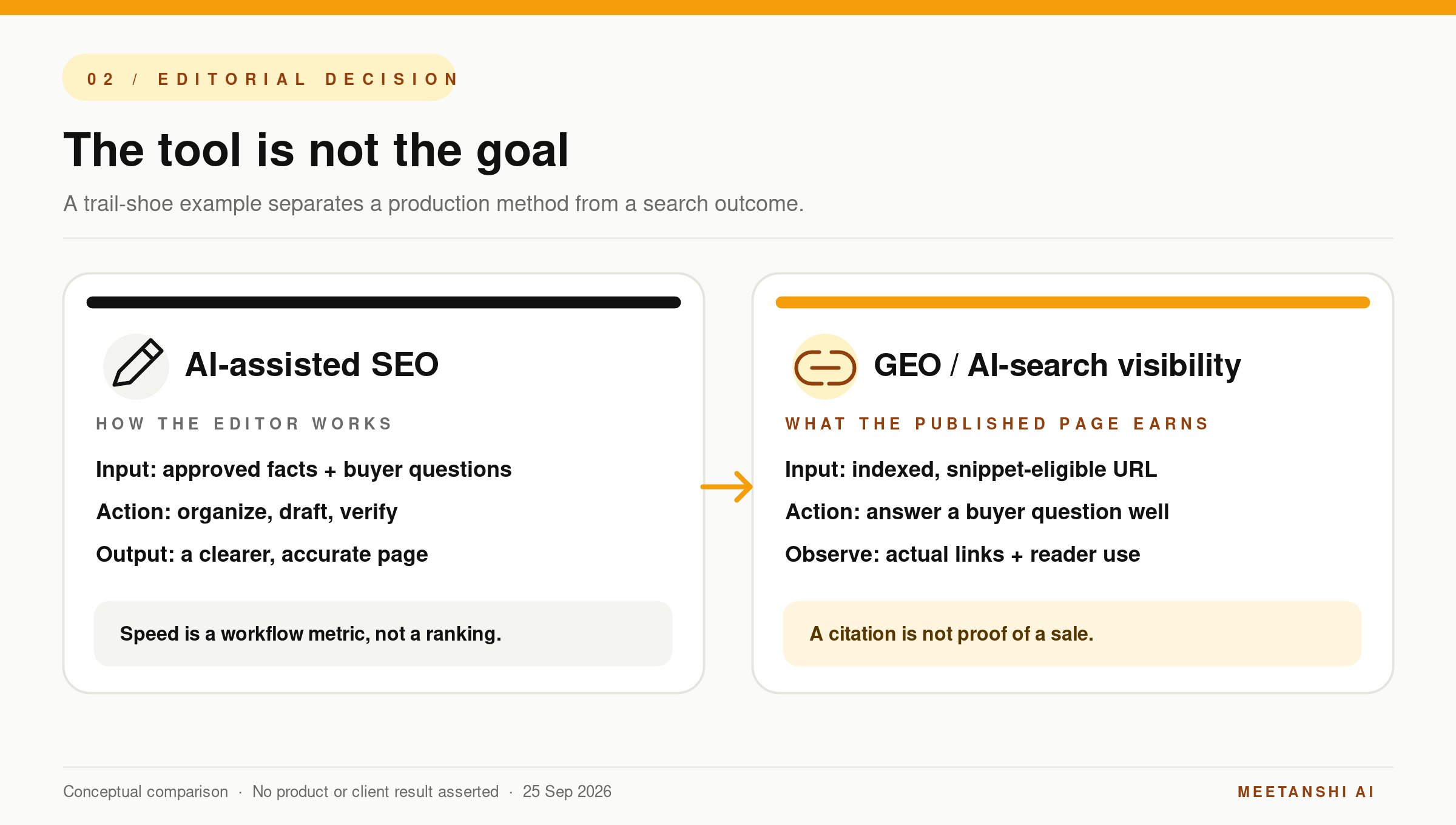
Suppose a store has a category page for trail shoes. An AI assistant can sort customer questions and help an editor spot missing answers. That is AI-assisted SEO: a way of doing the work. GEO, or optimization for generative search experiences, asks a different question: can a useful, trustworthy page be found and linked when someone asks an AI-powered search tool about trail shoes? One is a workflow; the other is a visibility goal. Neither excuses an inaccurate product page.
Google says its existing SEO guidance still applies to AI Overviews and AI Mode. It does not require special AI-specific schema or files for these features. A supporting link must be indexed and eligible for a snippet, but that does not mean it will be chosen (Google Search Central).
Follow one question through both workflows
Take "Which trail shoe should I wear in sustained rain?" Before writing, check whether the store's product records actually distinguish a waterproof membrane, a water-repellent treatment and a non-waterproof upper. Those are different claims; do not infer them from a product title. Also check the care notes and return policy. The hypothetical store and products here have no asserted specifications.
AI-assisted SEO can help the editor group approved product attributes, customer questions and missing evidence. It can draft a table that leaves unsupported cells empty. The editor decides whether the question is worth answering and verifies each fact against manufacturer documentation and the current catalog. "Faster first draft" is not a buyer benefit if it contains invented waterproof claims.
GEO/AI-search work starts with the published page. Is the canonical URL indexed and snippet-eligible? Does the opening distinguish the conditions a buyer cares about? Can a reader trace each recommendation to a product or manufacturer source? Check actual search surfaces for this specific buyer question. Google says these AI features may use related searches while forming a response, and their displayed links can vary (Google Search Central). Don't turn a single AI citation screenshot into a steady-rank claim.
A useful division of labor
| Job | Assistant may help | Human must decide |
|---|---|---|
| Product facts | Turn supplied specifications into a draft comparison with unknowns marked. | Confirm every specification, fit claim, policy and exception against current original records. |
| Buyer question | Cluster actual support questions supplied to it. | Choose the real question and answer it in plain language. |
| Page edit | Suggest an outline or identify repetition. | Publish only supported wording; check mobile layout, links and rendered page. |
| Measurement | Organize the observation log. | Interpret query-specific Search data and actual linked sources without claiming causation. |
A shop with no verified product facts should collect them first, not generate a polished-looking comparison. Google's people-first content guidance asks whether the content contains original information, trustworthy sourcing and a satisfying answer (Google Search Central).
Measure without mixing up the signals
A page-wide Search Console average position combines the queries for which that page appeared; it is not the rank of "trail shoes for sustained rain." Keep the query, date range and country beside your clicks and impressions. In a separate manual log, note whether an AI answer names the brand, links to your exact URL or does neither. A brand mention is not the same as a linked citation. A citation is not proof of sales. Business outcomes need their own measurement and enough observations to rule out a one-off result.
If the page is not indexed or is blocked from snippets, fix the ordinary Search problem first. If it is eligible but thin, improve an answer backed by product evidence. If the information is solid and publishing is slow, an AI-assisted drafting workflow with a source check may be worth trying. This is not a universal sequence for every store; the bottleneck decides the next skill.
For learning, the AI SEO course guide compares self-paced, assessed and live-feedback paths. Choose a format that lets you practice on a page you can inspect. For the wider store foundation, see Ecommerce SEO in 2026. Neither a course certificate nor a schema snippet can guarantee a place in an AI answer.
Sources: Google AI features, people-first content, How Search works. Verify any real store's specifications and current policy before adapting this example.