AI SEO Course: choose the work you need to produce
Choose by the artifact and feedback model you need—not acronym count, certificate badges or ranking promises. Compare self-paced courses, an open manual, live cohorts and an ongoing community.
3 primary paths8 also-consider options11 official provider pages10 coverage checks
Shivbhadrasinh accepts editorial responsibility for this guide. His public Meetanshi author profile identifies him as Co-founder and Chief Marketing Officer and says he has consulted online businesses for growth since 2010. We do not claim he completed these courses.
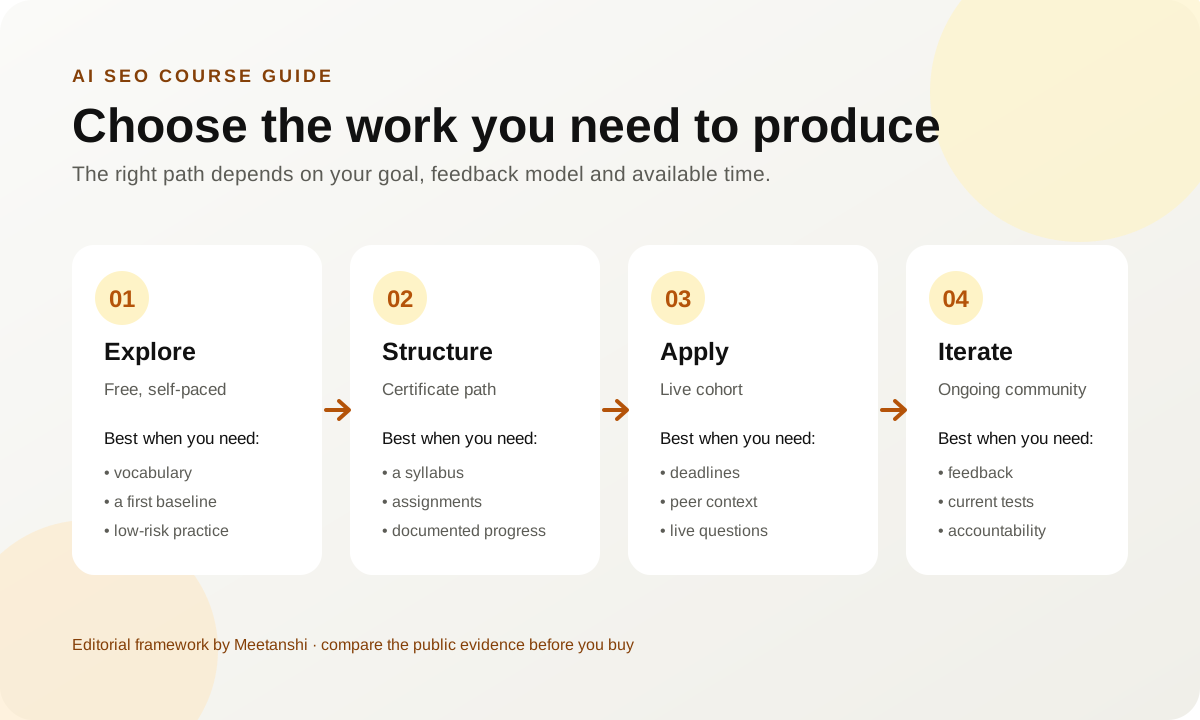
Choose the learning format by the work you need to produce: explore, structure, apply or iterate.
01 / Shortlist
Which AI SEO course fits your goal?
Start with these three primary paths. They represent free vendor training, a bounded assessed course and an ongoing live community. They are different formats, not a ranked league table.
Public provider information checked 18 September 2026. Prices and access can change. On smaller screens, scroll the table sideways.
AI SEO course comparison: artifact, feedback model and access
A tested campaign plan, AI-search baseline, answer-shaped pages and an experiment log
Weekly live support and Q&A, live site audits/teardowns and community resources; some resources are level-gated
Join button displayed $299/month. Promotional copy on the same page showed $289/month and a future $319+ amount; confirm checkout.
The artifact and fit are our editorial interpretation of each public syllabus. Formats and listed coverage come from the official pages; none is proof of teaching quality.
First learn crawling, indexing, search intent, internal links and measurement. You do not need to code to begin, but you should be able to edit a page and understand its purpose. Add AI-assisted drafting only after you can check its accuracy.
Prefer a structured certificate
Compare Coursera’s course with Semrush’s assessment route. Ask what the certificate requires and what access costs. A certificate documents completion; it does not establish Google endorsement or guarantee professional ability.
Have a project and a recurring budget
Consider AI SEO Rainmakers if regular feedback is the missing piece. Budget for renewal, not just the first month, and check that you can attend or use the offered support.
Run an ecommerce store
Prioritize factual product information, category-page usefulness, technical eligibility and a measurable test. Avoid any training that asks you to invent reviews or mass-publish near-identical pages. A useful first project is one buying guide, not a whole catalog rewrite.
What each option actually offers
Semrush Academy
AI Visibility Essentials with Semrush
A useful starting point if you want to connect AI-search terminology to a repeatable measurement workflow. The public syllabus makes the tools and metrics concrete.
Published coverage
Prompt research, AI share of voice, brand perception, third-party mentions, content and technical SEO.
Certificate
Semrush Academy certificate after the final assessment, according to the course page.
Before you enroll
Demonstrations are Semrush-specific. Confirm which exercises you can complete with your account before starting a software trial.
Our suggested follow-up exercise
Build a prompt set for one product category and separate brand mentions, linked citations and referral traffic in your report.
AI SEO: Mastering Generative Engine Optimization (GEO)
A focused option for turning familiar SEO concepts into an AI-search learning plan. The published structure includes assignments and content-mapping exercises.
Published coverage
Entities, topical authority, AI content mapping, GEO content formats and performance evaluation; names Google AI Overviews, Bing Copilot, Perplexity and ChatGPT.
Certificate
Shareable certificate listed; the page says certificate access requires the paid Certificate experience.
Before you enroll
“Enroll for free” is not proof that the full course or certificate is free. The page describes both real datasets in its outcomes and hypothetical datasets in a module; do not assume a live client project.
Our suggested follow-up exercise
Rewrite one buying guide around verified entities and buyer questions, then explain what changed and how you would evaluate it.
AI SEO Rainmakers is an ongoing practitioner learning community rather than a one-off course. The supplied classroom evidence shows a foundations path, advanced reverse-engineering/semantic/retrieval/training-data/campaign modules, tool and repo setup, vibe-coding lessons, live calls and audits. That makes it especially relevant to learners who want to apply experiments and bring real implementation questions.
Published coverage
Public page lists AI SEO support, tests with methodology, tools, repositories, site audits and new courses/information. User-provided classroom screenshots additionally show Foundations to AI SEO, Tools & Repos + Setup Guides, Learn Vibe Coding for AI SEO, The Advanced AI SEO Course, Using CharlesGPT 3.1, Live Site Audits & Teardowns, Weekly Call Recordings, Community Gold Vault and Private Expert Interviews.
Certificate
A certificate was not specified on the public about page checked.
Before you enroll
This is a recurring membership, not a fixed-price course. Confirm call times, cancellation and refund conditions, current course access and how the material fits your risk tolerance.
Our suggested follow-up exercise
Bring a documented crawl or content problem, establish a baseline, ask for feedback on one test, and record the hypothesis, change and outcome without treating correlation as causation.
These are secondary paths, not lower-ranked courses. Each earned a place because its current official page was directly fetched and it offers a distinct way to learn. We did not score teaching quality or claim first-hand experience.
Free, no-sign-up video course
Answer Engine Optimization (AEO) Course
Ahrefs Academy
A compact route from AI-search mechanics through content, brand-gap and measurement work.
Artifact
An AEO action-plan checklist and measurement setup
Feedback
Self-directed; no assessment or live feedback stated
Publicly stated coverage, not a teaching-quality score. Each entry reflects what the checked official page says. “Unknown” means the page did not establish the fact; it does not mean the course excludes it. Provider terms and curricula can change.
Primary path
AI Visibility Essentials with Semrush
Semrush Academy
SEO foundations
Content and technical SEO appear in the syllabus; a broad beginner foundation is not stated.
AI-assisted workflow
Content workflows and Semrush AI SEO Toolkit walkthroughs.
AEO / GEO
AI SEO strategy, prompt research, citations and third-party mentions.
AI Overviews / AI Mode
Unknown — not stated on the checked official page
Measurement / experiments
Share of voice, brand perception, AI visibility and traffic.
Assessment / certificate
Final assessment and Semrush Academy certificate.
Live feedback
Unknown — not stated on the checked official page
Runtime
20 videos listed; total runtime is not stated.
Access / price
Free enrollment; separate software access may be needed for exercises.
Foundations to AI SEO is visible in the private classroom; exact lesson inventory is not fully captured.
AI-assisted workflow
Tools/repos, setup guides, CharlesGPT, vibe coding, local/VPS, terminal, MCPs and plugins are visible in the classroom.
AEO / GEO
Advanced modules visibly cover reverse engineering, semantic SEO, retrieval techniques, training data and campaign building.
AI Overviews / AI Mode
Provider publicly references AI search; classroom screenshots show AI SEO campaign and retrieval work, but exact platform lesson coverage is not fully captured.
Measurement / experiments
Tests with methodology, baselines, live audits and campaign exercises are visible.
Assessment / certificate
Formal certificate or standardized assessment not stated; progress and level-gated classroom access are visible.
Live feedback
Weekly live support/Q&A, live site audits and teardowns are publicly/privately evidenced.
Runtime
Ongoing membership; fixed course runtime not stated.
Access / price
$299/month join button; same public page also says $289/month and future $319+. Verify checkout.
Update cadence
New courses and information every month; tools/repos and classroom progress are visibly maintained.
AI-assisted SEO is not the same as AI-search visibility
AI-assisted SEO: improve the workflow
Use an AI tool to help classify queries, propose content briefs, draft metadata or explain a technical issue. The output still needs human verification. The goal is better, more efficient SEO work—not simply more AI-written pages.
AI-search visibility: study the result
Observe whether a brand or page appears in an answer from Google AI Overviews, AI Mode or another answer engine. A mention, linked citation, click and conversion are different outcomes; track them separately.
SEO is the broader work of making pages discoverable and useful in search. AEO (answer engine optimization), GEO (generative engine optimization) and LLM visibility are overlapping industry labels for answer-oriented discovery. Course providers use the terms differently, so compare actual lessons and assignments rather than acronyms.
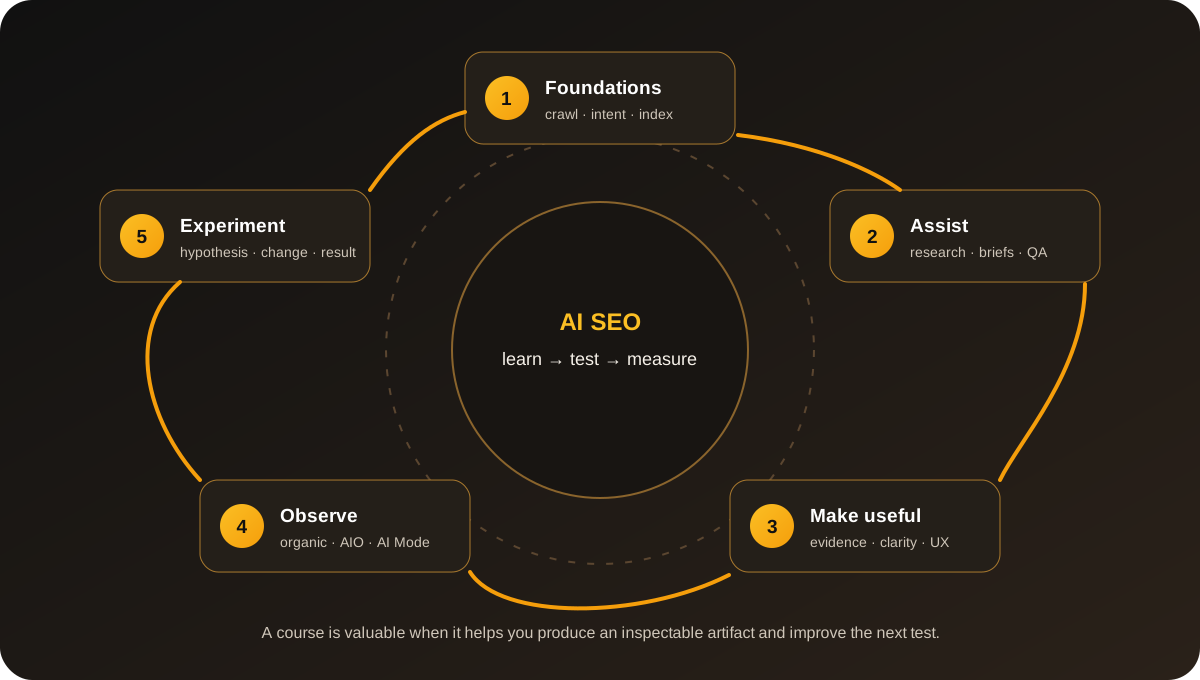
A useful course should move from foundations to an inspectable experiment—not stop at terminology.
06 / Turn lessons into evidence
Learning roadmap: five practical exercises
This is Meetanshi’s suggested practice plan, not a syllabus supplied by any course provider. Work at your own pace; each step ends with something you can inspect. Use a test site or an approved draft before changing a live business page.
Establish the SEO foundation
Use a site you own or have permission to inspect. Check one important URL for HTTP status, indexability, canonical, internal links and whether its main content is readable without JavaScript. Learn search intent before generating content.
Deliverable: a one-page baseline audit with evidence, not just a tool score.
Use AI as an assistant, not a source
Give an AI tool verified product facts and ask it to cluster buyer questions or draft an outline. Compare the output with the supplied facts. Remove invented specifications, citations and claims; keep private customer data out of prompts.
Deliverable: an annotated brief showing what AI proposed and what a human corrected.
Make one page more useful
Choose a category or buying guide. Answer the decision the reader is making, explain trade-offs, link primary sources and state limitations. Keep product price, availability and attributes consistent with the store. Use structured data only when it accurately represents visible content.
Deliverable: a before-and-after content draft with a factual QA checklist.
Observe AI-search visibility
Choose a small, fixed set of informational and comparison queries. Record Google organic results, AI Overviews and AI Mode separately; optionally add other answer engines. Save exact query, date, locale, device, sign-in state, answer, linked source URLs and whether an AI answer appeared.
Deliverable: a repeatable observation sheet that separates a brand mention from a linked citation.
Run a measured experiment
Write the hypothesis before changing the page. Change one meaningful thing, annotate the date and repeat your observations under the same conditions. Compare Search Console and referral/conversion data where available. Do not attribute every movement to your edit.
Deliverable: a short test report including null results, confounders and what you would test next.
Measure without confusing the surfaces
Keep a log with these fields: query, timestamp, location, device, account state, search surface, AI answer present, brand mentioned, exact linked URL, screenshot reference and notes. Repeat the same conditions over time. One personalized result is not a stable rank, and a tool’s synthesized search result is not direct Google evidence.
Google reports AI-feature search traffic within Search Console’s Web search data. That is not a complete citation log; pair it with documented observations and on-site analytics. None of these exercises can promise inclusion in an AI answer.
Your course selection checklist
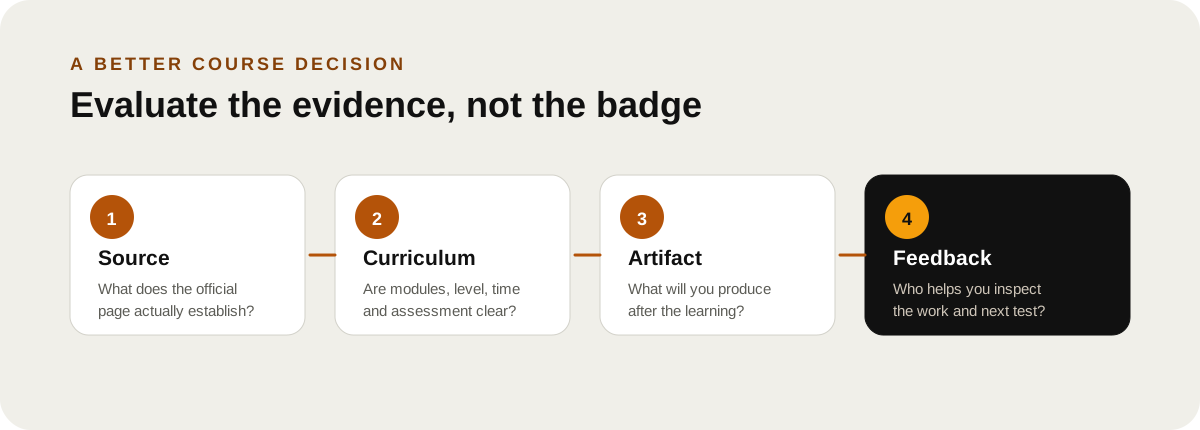
Before paying, write down the task you want to perform and the artifact you expect to produce. Then check the current syllabus, instructor access, assessments, tool costs, renewal terms, refund conditions and evidence behind outcome claims.
Does the course teach AI workflows, AI-search visibility or both?
Is there an exercise on a real page, with factual and technical quality checks?
Can you access the tools and attend the support sessions?
Is the price one-time or recurring, and what is excluded?
Are certificates, refunds and access duration clearly explained?
Does the provider distinguish experiments from guaranteed results?
Evaluate a course by its public evidence, curriculum, learner artifact and feedback model.
07 / Evidence & limitations
Selection methodology
We kept Semrush Academy, Coursera and AI SEO Rainmakers as three primary decision paths, then added eight secondary formats whose current official pages returned usable facts: Ahrefs’ free AEO videos, iPullRank’s open manual, Maven’s live cohort, CXL’s focused comparison-content course, Yoast’s certificate course, SearchAtlas’s free hands-on hub, Coursera’s professional certificate and HubSpot’s free AEO certification landing page. We compared the artifact a learner could produce, feedback model, public curriculum, runtime, access, assessment and update claims. This is a verified shortlist, not an exhaustive survey or scored ranking.
Official pages were fetched on 18 September 2026 and preserved as dated research snapshots. Shivbhadrasinh Gohil reviewed the evidence and accepts editorial responsibility. We did not enroll, audit private lessons, verify student outcomes or test instructors’ methods. “Unknown” is retained wherever a checked page did not state a fact.
We have not run a controlled study showing that taking any of these courses improves rankings or citations. We are not publishing a live SERP leaderboard: isolated screenshots do not establish repeatable positions, and a full, controlled AI Overview or AI Mode citation audit is not available for this guide. The roadmap explains how to collect that evidence instead of inventing it.
AI SEO course questions, answered
Can I do SEO with AI?
Yes. AI can assist research, classification, outlining and quality checks, but you remain responsible for accuracy, usefulness and technical implementation. Start with verified source material and review every factual claim. Automated output alone is not a strategy or evidence that a page deserves to rank.
Can I learn AI SEO for free?
Yes. Semrush and Ahrefs list free courses, iPullRank publishes its manual on the open web, and Google provides free documentation. Practice on a page you control using the roadmap here. Separate tuition from software costs: a free lesson that demonstrates a paid toolkit does not make the toolkit free.
Which certification should I choose?
Semrush lists an Academy certificate after assessment, Coursera lists a shareable certificate with paid-access conditions, and Maven lists a certificate of completion without public assessment requirements. Choose based on what you will learn and produce, not the badge alone. None establishes a Google-issued qualification or guarantees employment, rankings or AI citations.
Is GEO replacing SEO?
Not according to Google’s guidance for its AI features: SEO best practices still apply. Learning to observe generative answers adds a measurement and content-discovery perspective. It does not remove the need for crawlable, indexable pages, sound information architecture or helpful, trustworthy content.
How long does learning take?
Ahrefs lists 1 hour 26 minutes and Coursera estimates four hours. Maven advertises two live hours, but its two displayed 90-minute session times total three hours, so confirm the schedule. Semrush, iPullRank and CXL do not state a total runtime on the pages checked; Rainmakers is ongoing. Provider runtime describes lesson delivery, not mastery.