

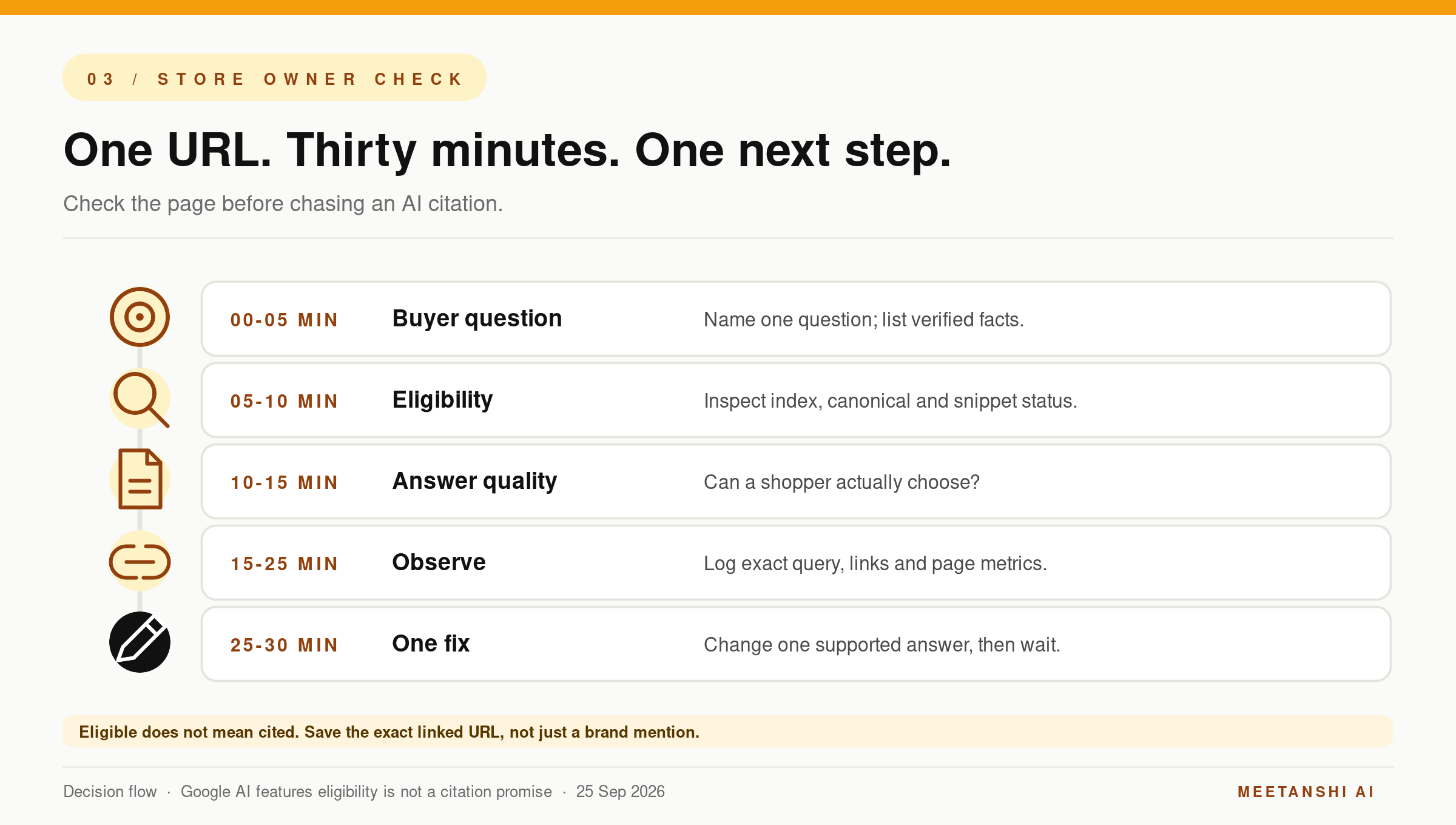
"How do we get cited?" is tempting, but start one step earlier: can Google use the page, and does it answer a buyer's question? Google's stated condition for a supporting link in AI Overviews or AI Mode is that a page be indexed and eligible to appear with a snippet. Passing that condition does not secure a citation (Google Search Central).
Set a timer, bring one URL and record the results. You are looking for the next useful edit, not a green score.
0-5 minutes: name the buyer's question
Choose a product comparison, category explainer or buying guide you control. Write one question it should answer. For example: "Which rain jacket is suited to a long wet commute?" This is an illustrative question, not a review of any particular jacket. Note which material, fit, care and return facts you can substantiate from real product records. Do not use a generic "best jacket" claim to conceal missing evidence.
5-10 minutes: inspect the URL
In Search Console URL Inspection, check the canonical URL, indexing state and last crawl. Open the live page. Can a reader see the answer? Is it available for snippets? If the URL is noindex or Google selected another canonical, solve that ordinary Search problem first. Google says there is no extra AI-only technical requirement or special schema for these features (Google Search Central). Accurate structured data can describe visible facts, but it cannot make up a missing product answer.
10-15 minutes: try to make a choice with the page
Pretend you do not know the catalog. Does the page explain the tradeoff for this buyer, or only repeat "durable, premium, perfect for all weather"? In the jacket example, the useful detail might be manufacturer-documented fabric, care, sizing and the current return terms. If the record is missing, write "verify with product team" in your notes. Do not invent a test, user review or performance number. Google's content questions ask whether people leave with enough information to meet their goal (Google Search Central).
15-20 minutes: sample the search surfaces
Search the exact buyer question and record date, country and device. Note ordinary organic results separately from any AI Overview. Open AI Mode if it is available and save linked pages and the statements beside them. A brand name with no link to your URL is a mention, not a citation. These results can vary between observations; preserve the setup with the screenshot rather than declaring a stable rank.
20-25 minutes: check the right numbers
Filter Search Console Performance to this URL and a stated date range. Record clicks, impressions and shown queries. Google includes AI feature traffic in overall Web performance data, but this report alone does not identify every specific AI answer that linked to you (Google Search Central). A page-wide average position is not an exact-query rank. Keep a manual citation log separate from Search Console.
Copy this observation line:
Date/time, country, device, exact query:
URL / index state / selected canonical / last crawl:
Organic result for this sample:
AI Overview present? / linked URLs:
AI Mode available? / linked URLs and nearby claim:
Search Console date range / clicks / impressions / shown queries:
25-30 minutes: choose one fix
Fix eligibility if it is broken. Otherwise, choose one supported answer passage, a useful internal link or a comparison a buyer needs. Save the exact before/after text, evidence for new claims and publication time. Check the live result on a phone. Schedule a later observation rather than trying to force a verdict today: crawling and indexing do not follow your 30-minute timer (How Search works).
If you want to learn this workflow yourself, our AI SEO course comparison sets out free, assessed and live-feedback options. Our AI Search and GEO service is a separate implementation route. Neither route promises a citation.
Sources: Google AI features, people-first content, How Search works. The jacket question is illustrative; check the live interface and each store fact before publishing.